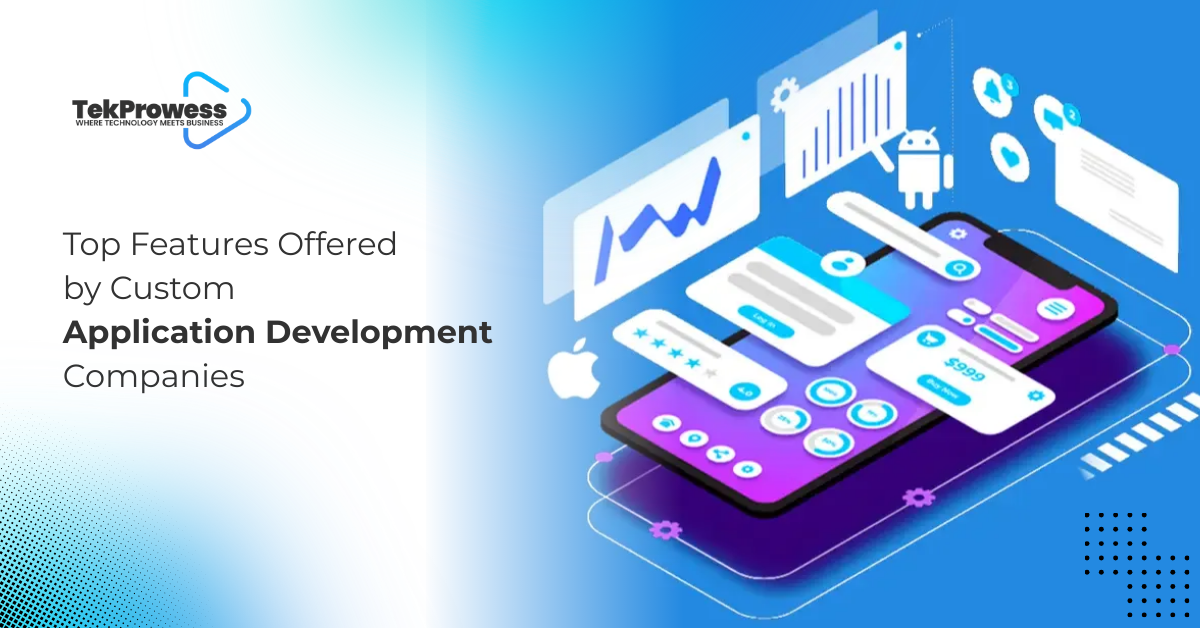
Top Features Offered by Custom Application Development Companies
As businesses accelerate their digital transformation journeys, the limitations of generic, off-the-shelf software become increasingly apparent.
By TekProwess
Enterprise Solution Architects
Rather than focusing solely on coding, these companies provide comprehensive digital engineering capabilities that span strategy, design, development, deployment, and optimization. Below are the key features that define high-performing custom application development partners.
1. Strategic Requirement Discovery
One of the most critical features is a structured discovery process. Before development begins, teams invest time in understanding business goals, technical constraints, user behavior, and industry challenges. This includes stakeholder interviews, workflow mapping, and feasibility analysis.
By translating business requirements into clear technical specifications, development teams minimize scope creep, reduce rework, and ensure the final application supports measurable outcomes such as efficiency, revenue growth, or customer engagement.
2. Scalable and Future-Ready Architecture
Modern applications must adapt to evolving user demands and market conditions. Leading providers design systems using scalable architectures that support long-term growth. Modular development, microservices, and cloud-native approaches allow new features to be added without disrupting core functionality.
This future-ready architecture ensures performance stability under increasing workloads while enabling seamless upgrades as business needs change.
3. End-to-End Technology Expertise
A defining advantage of working with experienced custom application development companies is access to full-stack expertise. From frontend interfaces to backend logic and databases, development teams manage the entire technology stack cohesively.
Their capabilities often include modern frontend frameworks, robust backend technologies, database optimization, API development, and system integrations. This holistic approach ensures consistent quality, performance, and maintainability across the application lifecycle.
4. User-Centered Design and Experience
User experience plays a decisive role in application adoption and success. Custom-built solutions prioritize intuitive design, accessibility, and responsiveness across devices. Designers collaborate closely with developers to ensure visual elements align seamlessly with functional requirements.
Through wireframes, prototypes, and usability testing, teams refine interactions to reduce friction, improve engagement, and support user productivity whether the application serves customers, employees, or partners.
5. Seamless System Integration
Most organizations rely on multiple digital platforms to operate efficiently. Custom applications must integrate smoothly with existing systems such as CRM, ERP, payment gateways, analytics tools, and third-party services.
Development teams focus on building secure APIs and integration layers that enable real-time data exchange, eliminate silos, and enhance operational visibility. This integration capability ensures the application becomes a central, value-driving component of the digital ecosystem.
6. Built-In Security and Compliance
Security is a core feature of enterprise-grade custom applications. Development teams follow secure coding practices, conduct vulnerability assessments, and implement role-based access controls. Data protection measures such as encryption, secure authentication, and audit logging are embedded from the outset.
For organizations operating in regulated industries, compliance with standards such as GDPR, HIPAA, or PCI DSS is addressed throughout the development process. This proactive approach significantly reduces security risks and regulatory exposure.
7. Agile Development and DevOps Practices
Speed and adaptability are essential in today’s competitive landscape. Custom application development companies commonly adopt Agile methodologies combined with DevOps practices to accelerate delivery without compromising quality.
This approach enables iterative releases, continuous testing, automated deployments, and faster feedback cycles. Businesses benefit from improved transparency, better collaboration, and the ability to respond quickly to changing requirements.
8. Cloud Enablement and Performance Optimization
Cloud technology has become central to modern application development. Development teams design applications to leverage cloud platforms for scalability, reliability, and cost efficiency. This includes containerization, serverless computing, and optimized resource allocation.
Performance optimization is addressed through load testing, monitoring, and fine-tuning to ensure applications remain responsive under real-world usage conditions.
9. Quality Assurance and Reliability
Rigorous testing is essential for delivering stable, high-performing software. Testing strategies extend beyond functionality to include performance, security, compatibility, and regression testing.
Automated testing frameworks combined with manual quality checks ensure issues are identified early and resolved before deployment. This results in reliable applications that meet both technical and business expectations.
10. Ongoing Support and Continuous Enhancement
The value of a custom application extends well beyond launch. Ongoing maintenance, monitoring, and enhancements are essential to keep applications aligned with evolving business needs.
Through post-deployment support, performance reviews, and feature updates, development partners ensure long-term sustainability and continuous improvement. This ongoing collaboration allows businesses to adapt quickly to market changes and emerging technologies.
Conclusion
By combining strategic insight, technical expertise, and a commitment to quality, custom application development companies deliver software solutions that go far beyond standard products. Their feature-rich approach enables organizations to build scalable, secure, and user-focused applications that support innovation and competitive advantage in an increasingly digital world.
Written by TekProwess
Enterprise Solution Architects
Specialists in enterprise ERP transformations, Odoo module customizations, and cloud solutions.